
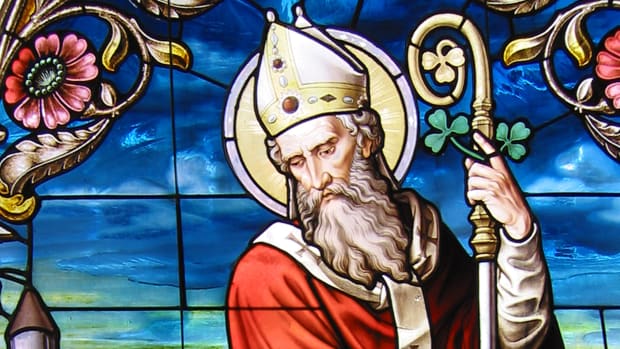
Category Archives: Love

“I, Patrick…”

In my mind I could still hear the old priest reading from the Scriptures. “Do you not know that if you present yourselves to anyone as obedient slaves, you are slaves of the one whom you obey, either of sin, which leads to death, or of obedience, which leads to righteousness?”

I thought little of these words at the time. Like many of the others of my age, I was too caught up in the world as it is to give much thought to the world to come. I cared little for the things of God; indeed, I had forsaken Him. To me, His commandments were burdensome and unnecessary. His priests were no more than the spoilers of my sport, and just as I did not see the kindness and patience of God toward me, I did not see that the old man who spoke to his flock of God’s kingdom did so because he loved us.

And then, like so many others, I was taken.

I remember only a few details of when the Irish slavers first captured me. All of us had been laughing and enjoying a rare cloudless day when they came. There was no fighting them. The Roman Legions had left our island years before, and the only defenses that remained were the small militias we could muster; but the raiders struck so quickly that these were of little help. I was captured, then tied to others, then led to their ship, and then across the Irish Sea to what would be my home for six years.

How quickly my life became a walking parable! I, Patrick, who had been a slave to sin, was now a slave to men, forced to do work for which my only recompense was scant sustenance. I served my new master well; what else could I do? From my first day as a slave I tended my master’s sheep; six years I continued in forest and mountain, in all kinds of weather, caring for another man’s flock.

All the while I prayed. Sometimes I would pray a hundred prayers a day; sometimes I would pray all night, until, in the morning, both the ground about me and the cloak drawn across my shoulders were covered in frost. I couldn’t have imagined, wasting my life on lesser things back in Britannia, that here in the Irish wilderness, my freedom taken from me, I would find in Christ what it was to be truly free. It was good for me that I was so afflicted, for my affliction led me heavenward. The God I had forsaken had not forsaken me.

My Companion, my Lord, was always with me. I knew He was present, and often He brought to mind the things I had long forgotten, things my father or our priest had said about following Christ. Often, I would hear His Word in my mind, and it was more precious to me then than all the riches of Rome. I lamented only that I could not remember more! But then, God spoke a Word I had not heart before.

One night, as I lay sleeping, I heard a voice speaking. I saw no figure, no vision in the night. But, like Elijah, I heard a whisper. “Soon you will return to your own country.”

I woke. But the whisper did not cease playing and replaying in my mind. Could it be true? Was this You, O Lord? The Apostle told us to pray without ceasing. How ceaseless were my prayers the following week! I hardly breathed without uttering my sincere hope that what I had heard in my dream was indeed the voice of my God.

I was not to wait long for confirmation. A few days after this dream I had another. The same whisper spoke to me, “Your ship is waiting. Go.” When I rose from my sleep, I knew that I must obey. The journey would be difficult. The ship He had shown me was some two hundred miles from where I was. But, I trusted Him. I knew that He had loved me even before I knew Him, before I loved Him. He Who had not forsaken me, would not forsake me.

I left my master without his knowledge. The Lord was my Master now, and I knew I must obey God rather than man. But as I left in the twilight, the sheep stirred. Even as I made my way over the first hill and they could no longer be seen, I heard them bleating. A tear warmed my cold cheek. How affecting is the cry of the sheep who have no shepherd!

But where my Lord called, there I would go. I found my ship waiting where He had said, and though the captain refused me at first, my Captain softened his heart and they brought me aboard.

I returned home, no longer the man I was. But it would not be long before I dreamed yet another dream from the Lord. In my dream I heard the cry of sheep without a shepherd, a people dwelling in darkness and crying for the light. I knew them. I had seen them before, heard their voices. In Ireland.

Where my Lord called, there I would go.

_____________________________________________________________________________________

There have been many myths that have built up around the historical Patrick, Bishop of Ireland. However, the true story is one of a loving pastor who, being freed from slavery in Ireland, one day returned to the place of his slavery in order to share the gospel of Jesus Christ with those enslaved to sin. We have only two works by Patrick – his Confession and his Epistle to Coroticus. The tale I related above is a dramatized account of his own testimony in his Confession. Of course, the Feast of St. Patrick occurs this month in the liturgical calendar, but St. Patrick’s Day, like many of our holidays, has become something completely different than what it was originally. This 17 March, perhaps we can instead set apart some time and meditate on God’s gracious working in and through the life of Patrick of Ireland.


Sojourn: A Brief Meditation

The world is quiet around me. And yet it’s not. The bright white of the falling snow, the underlying ice that has frozen the earth, the occasional sing-song chatter of hungry birds, the icy crying wind, and the passing of those who will not be deterred by the winter’s stormy countenance – I see, feel, hear all of these. And yet, there’s something quiet about a snowy day. It is as though, under its milky blanket the earth silently and eagerly awaits the thaw. It may be a cliché that has long been played out, but it is one we do well to remember: winter is awaiting its end, and even in its stillness it presses on to the spring, when the pure white will give way to brilliant greens and the multitudinous colors of God’s gardens, just as light shone through a prism reveals itself to be more than what we first saw. I am an exile, a sojourner to a home I’ve never yet seen, to a spring that will not end. This home is promised to me, the city of wholeness and peace, the New Jerusalem (Rev. 21:9-27); I wait, and at the very same time, I press on. I wait… for the Lord must come again and consummate His kingdom. I press on… “I journey to find the place where I will be resurrected,” as the missionary disciples of Columba said. I am a knight of heaven, a son of the King, in this world and in the next. This winter will end; it will not always be this way. In “this world with demons filled” (Luther), we are the church militant, the church sojourning; but the Son will come, and with this winter past, we shall be the church victorious, the church at rest at last. Let us wait for His salvation; let us press on to know Him, to do the works He has prepared for us to do (Eph. 2:10), and one day to see Him with our own resurrected eyes.

“So then, brothers, we are debtors, not to the flesh, to live according to the flesh. For if you live according to the flesh you will die, but if by the Spirit you put to death the deeds of the body, you will live. For all who are led by the Spirit of God are sons of God. For you did not receive the spirit of slavery to fall back into fear, but you have received the Spirit of adoption as sons, by whom we cry, ‘Abba! Father!’ The Spirit himself bears witness with our spirit that we are children of God, and if children, then heirs – heirs of God and fellow heirs with Christ, provided we suffer with him in order that we may also be glorified with him. For I consider that the sufferings of this present time are not worth comparing with the glory that is to be revealed to us. For the creation waits with eager longing for the revealing of the sons of God. For the creation was subjected to futility, not willingly, but because of him who subjected it, in hope that the creation itself will be set free from its bondage to corruption and obtain the freedom of the glory of the children of God. For we know that the whole creation has been groaning together in the pains of childbirth until now. And not only the creation, but we ourselves, who have the firstfruits of the Spirit, groan inwardly as we wait eagerly for adoption as sons, the redemption of our bodies. For in this hope we were saved. Now hope that is seen is not hope. For who hopes for what he sees? But if we hope for what we do not see, we wait for it with patience.” Romans 8:12-25

“These all died in faith, not having received the things promised, but having seen them and greeted them from afar, and having acknowledged that they were strangers and exiles on the earth. For people who speak thus make it clear that they are seeking a homeland. If they had been thinking of that land from which they had gone out, they would have had opportunity to return. But as it is, they desire a better country, that is, a heavenly one. Therefore God is not ashamed to be called their God, for he has prepared for them a city.” Hebrews 11:13-16

“For God alone my soul waits in silence; from him comes my salvation.” Psalm 62:1

“Toil passes, and rest will come; but rest only through toil. The ship passes, and you arrive at home; but home only by means of the ship. We are sailing the high seas, after all, if we take account of the surges and storms of this world. The reason, I am convinced, that we are not drowned is that we are being carried on the wood of the cross.” Augustine, Sermones ad populum, sermon 104.

Prayer: O Lord, God of sojourners, Who brought His ancient people from slavery in Egypt through the wilderness and to the Promised Land, and have in Christ vouchsafed to bring Your church unto Yourself in the New Jerusalem, protect us as we journey on, and strengthen our waiting faith that the homeland we behold with the eyes of faith now will be the homeland we see in joy with our resurrected eyes when Christ returns to judge the world. We ask in the name of Him Who bore the winter that He might bring His people to the everlasting spring, our Lord Jesus Christ, Who reigns with You and the Holy Spirit, One God, forever and ever. Amen.

“Your Valentine”

Asterius, the Roman judge, a man respected by all who knew him, even more by those who knew only his reputation, sat weeping in the dark like a lost child.

This was not the first time. During the day he played the part expected of him – honorable, grave, and firm. To his servants he was a fair master. To his wife he was a loving husband. And to his little daughter…

The tears flowed freely as he sobbed alone. “My little girl… what will become of you, my sweet Camilla?” The child had reached her sixth year and had only ever known darkness from her entrance into this world. Though she could not see, she was not unhappy; she played with the other children, had learned to navigate the home and its surroundings, and her smile brightened her father’s darkness. But at night, while Camilla lay sleeping in her bed, and his wife in hers, Asterius would mourn his daughter’s blindness and weep for her future.

“Why do you weep, Asterius?” A voice pierced the surrounding night.

It was Valentinus the Christian. As Asterius turned toward the voice, he could make out by what little light there was the man’s long, flowing white hair. Valentinus was not an old man, but his hair was white as snow; indeed, something about his eyes seemed ancient. For his crimes against the Emperor, crimes which included being a leader in the movement he called The Way, and performing marriages in the name of the Jew, Jesus, Valentinus had been arrested and imprisoned. Because he was a citizen of Rome, he avoided the executioner’s block and the common pits where they generally threw the undesirables. Instead, Asterius had put him under house arrest… and that in his own house. Something about the man…

“I weep for my daughter’s blindness,” he replied. “I weep because the gods have cursed her with this fate… have cursed her, my flower, my sunshine!” At this he dropped to the ground, weeping uncontrollably.

“I weep… every night I weep… because no matter how many offerings I offer, how many prayers I raise to them, she is still blind!” He looked deeply into the ancient eyes of Valentinus. “How can one bright as she live in such darkness? The gods are cruel!”

The bishop sat on the ground beside Asterius and placed a comforting hand on his shoulder.

“I once had a child, a son. His name was Gaius, but my wife and I called him ‘little cub.’ I loved him dearly; I loved her… My fondest memory is of them. I can see him playing at her feet. I can see the sun shining through her golden hair.” Valentinus smiled.

“What happened to them?” Asterius asked.

“My Lord took them to Himself,” he replied. “But I will see them again!”

“How do you know? How do you know that this life is not all there is? that the gods are not just stones?”

“Your gods are stones, Asterius,” Valentinus answered. “Nothing more. They do not hear you because they cannot hear you. I know I will see my wife again because my God lives; because the Christ has risen, my wife and my son will rise also unto a new and everlasting life, as will all who have trusted in Jesus.”

Asterius’ mind, always reaching for a hope, began to calculate upon the words of his prisoner. Valentinus was here in his home for espousing this atheism, this denial of the Roman gods. But, Valentinus’ faith was stronger than his own. True, the bishop might have denied the gods, but he did so because he believed his God was true and living. Perhaps this God would hear the prayers that had so long gone unheard by stone; perhaps He would answer the prayers of His white-haired servant.

“Valentinus, can your Jesus heal my daughter? You say He hears you; will you pray that my Camilla will see? I am a wealthy man. Ask whatever you wish, and if I can do it, I will. But please, beseech your God to heal my sweet girl! Please!” Asterius grasped Valentinus’ hand, the judge begging the prisoner for his help.

“I will pray for your daughter,” said Valentinus. “And all I ask of you is that when my Jesus has given your daughter sight, you and your household turn from these dead stones to the living God in faith, and that you be baptized and taught The Way.”

Asterius consented. Perhaps he knew that becoming a Christian meant becoming an outsider, a persecuted and hated thing in the eyes of all Romans. But he didn’t care about “the eyes of all Romans”; he only wanted his little girl to see. Gently, he woke his wife and told her what Valentinus had said. She rose from bed and went with him to wake Camilla. Within a few moments, he was again on the terrace before the white-haired bishop.

The girl was not frightened or in the least alarmed by everything that was transpiring. Rather, she seemed to see more clearly than those around her that all would be well as her father placed her in Valentinus’ arms.

He looked upon the girl with a deep love, the love of a father for his child, and then, closing his eyes, he prayed: “Father, hear my prayer for the sake of Your Son, Jesus the Christ! You Who make the seeing and the blind, Who sent Your Son to open the eyes of those who could not see, open her eyes. Be glorified this night, my Lord!”

There was no lightning bolt that split the sky. There was no earthquake that sent the surrounding columns tumbling to the earth. No, that night, a little girl smiled and laughed when she looked with her own opened eyes into those of the white-haired man who held her. And Asterius and his wife fell to their knees, weeping tears of joy and thanking again and again the God Who lives!

The coming days would see the breaking of Asterius’ household gods, the deaf idols of stone in which he had once trusted. He and his wife and his servants would all be catechized and baptized by Valentinus over the following weeks, as would little Camilla, to whom Valentinus became a second father. After his release, the bishop and Camilla would often write to one another, maintaining their friendship through their correspondence.

Eventually, Valentinus would be arrested again for following Christ and for performing Christian marriages for believers who loved one another. This time, however, he would be brought before the Emperor Claudius II, and when Valentinus attempted to convert the Emperor to Christianity, Claudius ordered his execution.

Before he died, Valentinus wrote a final letter to his daughter in Christ:

My sweet girl,

I go now to our Lord, to await the resurrection of the dead. This is not the end. Just as my beloved wife and son have gone before me, so now I am going before you. But we will meet again. One day our eyes that see so dimly here will look upon the glorious face of our Lord Jesus and we will live forever with Him in His Kingdom. Remain steadfast, dear one, and walk in the Way of Christ our Savior. My love for you and for your family does not die with my body; love goes on, and I will carry it with me to heaven. Even when all else fades, love endures.

Grace and Peace to You,

Your Valentine

___________________________________________________________________________________________

Valentine’s Day, or The Feast of St. Valentine, will soon be upon us. Valentine (Latin, Valentinus) is a difficult personage to nail down historically; Valentinus was a common name between the 2nd and 8th centuries, and there are numerous martyrs who bore this moniker. What I have presented here is my own take on the tale most commonly told about THE Valentine after whom the day is named; that is, he was a bishop near Rome who was martyred at some point around 270 AD for his faith and for performing Christian marriages. Tradition gives us the tale of his healing the judge’s blind daughter. Little else is known about this particular historical Valentine; of course, my account is fictionalized and I took artistic and historical license, but I hope the message gets through. Happy Valentine’s Day!

“Let me not to the marriage of true minds
Admit impediments. Love is not love
Which alters when it alteration finds,
Or bends with the remover to remove.
O no! it is an ever-fixed mark
That looks on tempests and is never shaken;
It is the star to every wand’ring bark,
Whose worth’s unknown, although his height be taken.
Love’s not Time’s fool, though rosy lips and cheeks
Within his bending sickle’s compass come;
Love alters not with his brief hours and weeks,
But bears it out even to the edge of doom.
If this be error and upon me prov’d,
I never writ, nor no man ever lov’d.” William Shakespeare, Sonnet 116

“Then I heard what seemed to be the voice of a great multitude, like the roar of many waters and like the sound of mighty peals of thunder, crying out, ‘Hallelujah! For the Lord our God the Almighty reigns. Let us rejoice and exult and give him the glory, for the marriage of the Lamb has come, and his Bride has made herself ready; it was granted her to clothe herself with fine linen, bright and pure’ – for the fine linen is the righteous deeds of the saints.” Revelation 19:6-8

“Husbands, love your wives, as Christ loved the church and gave himself up for her, that he might sanctify her, having cleansed her by the washing of water with the word, so that he might present the church to himself in splendor, without spot or wrinkle or any such thing, that she might be holy and without blemish. In the same way, husbands should love their wives as their own bodies. He who loves his wife loves himself. For no one ever hated his own flesh, but nourishes and cherishes it, just as Christ does the church, because we are members of his body. ‘Therefore a man shall leave his father and mother and hold fast to his wife, and the two shall become one flesh.’ This mystery is profound, and I am saying that it refers to Christ and the church. However, let each one of you love his wife as himself, and let the wife see that she respects her husband.” Ephesians 5:25-33