
Tag Archives: Poetry

Through It All

Where shall I go from your Spirit? Or where shall I flee from your presence? If I ascend to heaven, you are there! If I make my bed in Sheol, you are there! If I take the wings of the morning and dwell in the uttermost parts of the sea, even there your hand shall lead me, and your right hand shall hold me. If I say, “Surely the darkness shall cover me, and the light about me be night,” even the darkness is not dark to you; the night is bright as the day, for darkness is as light with you. Psalm 139:7-12

So fades the flower of the day,

The brilliant colors of the light;

So mists of sorrow hide the way,

And I descend into the night.

How long, O Lord, shall this be so?

When will I see a newborn sun?

Why must I now in mourning go,

As with my tears all joys run?

I long to fly on dawn’s bright wings,

And taste the sweetness of the morn.

My starless sky no pleasure brings –

A womb from which no babe is born.

But darkness is not dark to You.

Though I am blind, You clearly see.

I trust You know my groanings, too,

And have ordained to rescue me.

Should I to heaven’s glories rise,

Or to the depths of Sheol fall,

Lord, grant me hope and faith-filled eyes

To see You near me through it all.
Jenny Geddes’ Stool

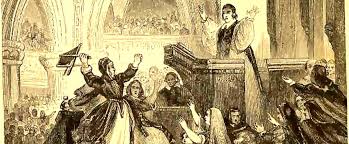
One of my favorite (and one of the funniest) stories in the history of Scottish Presbyterianism is that of Jenny Geddes. When King Charles I took the throne, and with his Archbishop of Canterbury, the rogue William Laud, sought to remove the Reformed influence from the Church of England, they also thought it best to introduce an episcopal prayer book for (what was at that time) the nominally episcopal Church of Scotland. Upon its first reading in St. Giles’ Cathedral in Edinburgh (which had been the church of John Knox in a previous generation), a market-trader named Jenny Geddes stood up and tossed her stool at the priest’s head. A riot ensued which eventually led to what was called “The Bishop’s War” in which Charles I tried to suppress the Scots. The Scottish Covenanters (those who had signed the National Covenant in 1638) defeated both Royalist forces and the English army, episcopacy was expelled from Scotland, and the Church of Scotland became purely Presbyterian. Of course, there’s much more to the story than this, but it’s an interesting take that, seemingly, Presbyterianism in Scotland grew to prominence after a long decay through one woman who was fed up with royal and episcopal interference in the Kirk.

King Charlie’s dog did bark his bark

From the dais of St. Giles’ kirk.

Brave Jenny could not keep her seat,

But rose indignant to her feet

And at his head she tossed her stool,

Hard at episcopacy’s fool:

“The de’il wi’ colic fill your bowels!

No mass book’s consonants or vowels

Will uttered be in Scottish ears!”

Then others shook the kirk with cheers.

To those who lead, be still and learn,

Or else ye too will have your turn;

Your sycophants may kiss your ring,

But in the Kirk, the Christ is King!


God’s Bow

The ark had sat on Ararat,

When God had stopped the rains.

With happy song the wild throng

Marched down onto the plains.

The days rushed on from dawn to dawn;

No rain clouds could he see.

So, Noah prayed with thanks arrayed

To be alive and free.

The dark days flown, the sun now shone,

But on the edge of sky

A hint of gray soon hid the day

And over all did lie.

Bright lightning lashed and thunder crashed;

The earth did hold her breath.

Would now the rain begin again,

And flesh know nought but death?

But as twas sent, so thus it went,

And left a savor sweet.

Though all did hide, not one had died,

The rainstorm now complete.

Above the song of birds ere long,

A solid promise hung;

For there God’s bow did brightly glow,

No longer shot nor strung.