
Learning from Then for Now and Tomorrow

“The teachings of our godly fathers are scorned. What the apostles have handed down is vilified. The inventions of modernizers are fashionable in the churches. Instead of being theologians, men are now fabricators of devious new systems of belief. The glory of the cross has been rejected, and the wisdom of this world wins the top prizes. The shepherds are driven away, and in their place dreadful wolves come in, hounding the sheep of Christ. The houses of prayer stand empty; mourning crowds have retreated into the desert. The older folk weep when they compare the present with the past. The younger folk are to be pitied all the more, for they don’t even know what they’ve lost.”

How descriptive of the church of our time! Someone who recognizes and states so plainly the straits in which the modern church finds herself is surely someone worthy of a hearing! But, if you read this thinking it to be a Keller or a Ferguson or a Trueman, you are mistaken.

It’s Basil of Caesarea… and it was written in the fourth century.

Truly, we have much to learn from our past for the sake of our present… and our future!

A Hymn for Midday (Qua Christus Hora Sitiit)

The following is my metrical translation of a Latin hymn from the Middle Ages. Its original author is anonymous; in fact, the date of its composition isn’t certain (probably sometime between the 12th and 16th centuries). Its usual time of singing, however, is the hour of Sext (or noon, the sixth hour). The first two lines reflect two different occasions. The first comes from John 4. Jesus enters the town of Sychar, and wearied from His journey, sits by Jacob’s well; John tells us that the time “was about the sixth hour.” (John 4:6). This is the setting for the “Samaritan Woman at the Well” episode in which our Lord Jesus asks the Samaritan woman for a drink (John 4:7-14ff.). Of course, as the second line reminds us, Jesus also suffered on the cross during the sixth hour; thus, the author directs our minds to the Lord’s thirst on the cross. And as we remember how our Lord thirsted, we sing that we would be thirsty – not for water, but for righteousness in Christ (Matthew 5:6), and hungry – not for food, but for Christ Himself (John 6:48-51)! We who are united to Christ through faith by the working of the Holy Spirit are led and empowered by the Spirit to mortify the flesh (Romans 8:13; Colossians 3:5-6) and to put on christlikeness (Colossians 3:12-17; Ephesians 4:17ff.). This short song is an excellent reminder in the middle of the day that we are to live for Christ always!

Notes: 1) The lyrics may be sung to any 8.8.8.8. tune; I prefer Old 100th (e.g., “All People That on Earth Do Dwell” or “Doxology”). 2) In the second stanza I translate “cosmic crime” rather than “sin” because the word that is used here is not the typical Latin word for “sin” but for “crime”, and as the crime is against the Lord, it is a crime of cosmic treason (to quote the late Dr. Sproul). 3) That being said, the song is not an exact translation, but near as I could be in this particular poetic form.


The hour on which the Christ did thirst,

Or on the cross did wrath endure –

Enrich us as we sing this hour

With deeper thirst for righteousness.


May we a hunger also feel

Which He Himself may satisfy,

That cosmic crime might make us sick

And virtue be our soul’s desire.


O may the Holy Spirit’s gift

So rush into us as we sing,

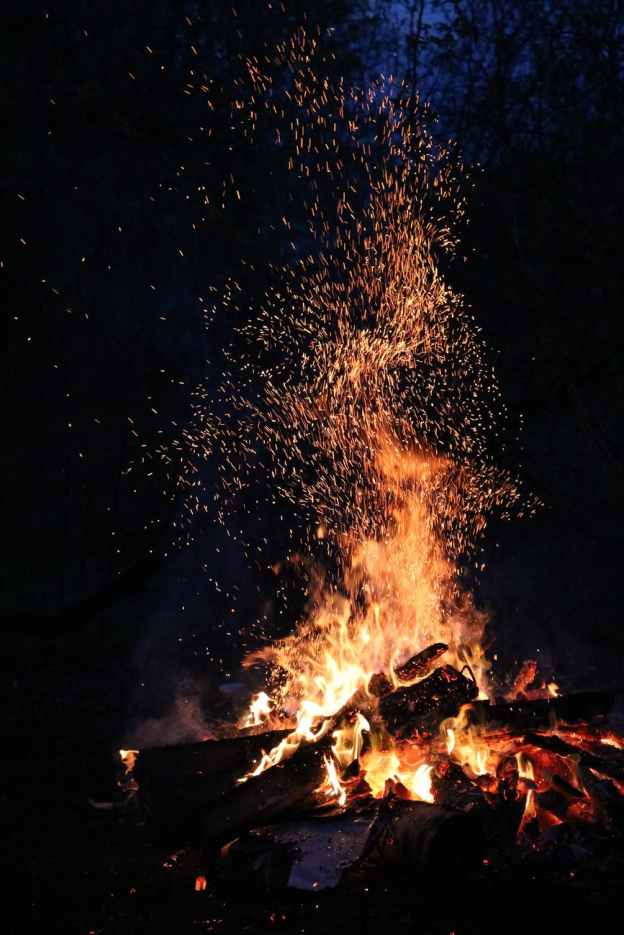
That carnal fires may be cooled

And cold minds boil with fervent heat.

Loving God with Augustine

As you think on these words from Augustine’s Confessions, prayerfully seek a deeper love for God, a love inflamed in us by the fruit-producing work of His Holy Spirit (Gal. 5:22)! Pray continually (1 Thess. 5:17) that, as you daily spend time in the Word, the Holy Spirit would give you a deeper love for the God Who Is, He Who has gloriously revealed Himself to us in Christ clothed in the gospel!

For he who loves along with you anything that he does not love for your sake, loves you the less. O Love ever burning and never extinguished, Love, my God, set me ablaze! Augustine, Confessions, 10.29.40.

Wretched and restless indeed are those spirits which are carried away by this downward flux, revealing the depths of their darkness, stripped as it is of the raiment of your light; but through that very restlessness you give abundant proof of the greatness of your rational creation, which is unsatisfied and cannot know blessedness and rest in anything less than you, and hence not even in itself. For it is you, O Lord, who will lighten our darkness; from you arise our raiment, and our darkness shall be as the noonday. Give yourself to me, O God; restore yourself to me. Behold, I love you; if that is not enough, let me love you more strongly. I cannot measure and know how much love I lack; how much more would be enough to make my life run to your embraces and not turn aside until it was hidden in the hidden depth of your countenance. This alone I know: that without you it is not well with me, not only outwardly but also within myself, and that all my wealth that is not my God, is poverty. Augustine, Confessions, 13.8.9.