
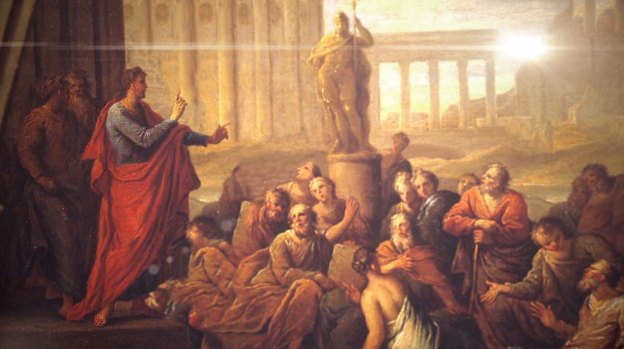
And they took him and brought him to the Areopagus, saying, “May we know what this new teaching is that you are presenting? For you bring some strange things to our ears. We wish to know therefore what these things mean.” Now all the Athenians and the foreigners who lived there would spend their time in nothing except telling or hearing something new. So Paul, standing in the midst of the Areopagus, said: “Men of Athens, I perceive that in every way you are very religious. For as I passed along and observed the objects of your worship, I found also an altar with this inscription, ‘To the unknown god.’ What therefore you worship as unknown, this I proclaim to you. The God who made the world and everything in it, being Lord of heaven and earth, does not live in temples made by man, nor is he served by human hands, as though he needed anything, since he himself gives to all mankind life and breath and everything. And he made from one man every nation of mankind to live on all the face of the earth, having determined allotted periods and the boundaries of their dwelling place, that they should seek God, and perhaps feel their way toward him and find him. Yet he is actually not far from each one of us, for ‘In him we live and move and have our being’; as even some of your own poets have said, ‘For we are indeed his offspring.’ Being then God’s offspring, we ought not to think that the divine being is like gold or silver or stone, an image formed by the art and imagination of man. The times of ignorance God overlooked, but now he commands all people everywhere to repent, because he has fixed a day on which he will judge the world in righteousness by a man whom he has appointed; and of this he has given assurance to all by raising him from the dead.” Now when they heard of the resurrection of the dead, some mocked. But others said, “We will hear you again about this.” So Paul went out from their midst. But some men joined him and believed, among whom also were Dionysius the Areopagite and a woman named Damaris and others with them. Acts 17:19-34
Most people are familiar with the narrative of Paul’s evangelizing of the philosophers in Athens at the Areopagus (or, Mars’ Hill). No doubt you have likely heard numerous messages and read many articles about the need for contextualizing the message. It is certainly a necessary point to take away from this passage; but it’s one thing to say we need to contextualize, and yet another to do it faithfully without changing the message. We learn to do both from this passage.
When Paul came to Athens, “he reasoned in the synagogue with the Jews and the devout persons” (Acts 17:17); this he would have done primarily through the Old Testament witness to Christ, reasoning with them from the Scriptures that Jesus is the Christ, the Son of the living God. But, when he came to the philosophers who would have most certainly been from the prevailing schools of the time – Stoicism and Epicureanism, among others – reasoning from Scriptures they didn’t know wouldn’t have done much good. The people of Athens itched to hear something new. In this way, they are very much like the people of our own day and time! Paul, who had been preaching the gospel in the marketplace, was therefore brought to the Areopagus to share his new teaching with a large audience. There, though he certainly preached the truth of the Scriptures, he didn’t use the Scriptures to preach it.
The Jews in the synagogue knew from Scripture that the God of the Old Testament was the only God. The people of Athens, though, worshiped numerous gods. They were certainly a religious people, but their religion was one of pagan idolatry; so religious were they that they had even erected an altar to an unknown god – that is, they had made as many idols as gods that they knew, and to keep any that they missed from being unhappy and smiting them, they decided to set up a catch-all altar.
Paul saw their idols. There was one to Zeus, king of the gods and serial rapist. There was one to Athena, goddess of wisdom who popped out of Zeus’ forehead; after intercourse with Athena’s mother, Metis (who was either Zeus’ wife as we see in Hesiod’s Theogony, or yet another of Zeus’ victims as we see in Apollodorus’ Library of Greek Mythology), whom he then swallowed whole in the form of a fly, Zeus had a terrible headache that could only be relieved by an axe blow to the noggin, which resulted in Athena rising fully grown out of her dad’s skull! I would say you can’t make this stuff up, but some pagan did make it up, so there you are. There was a statue of Hera, Zeus’ sister and wife, who was understandably upset most of the time because of her husband’s numerous adulteries; for example, she was so upset that Zeus had raped Alcmene, the wife of Amphitryon, that she decided to take out her anger on the resulting child, Alcides, sending serpents to kill him as a baby (didn’t work; he strangled them), and later by driving him mad so that he killed his wife and children. By the way, Alcides’ name would be changed to “the glory of Hera” in an attempt to appease the petty goddess; you know him better as Hercules. The Apostle likely passed altar after altar, idol after idol of pagan gods that were just as wicked as sinful human beings, gods made after our image. Then, he came to the altar “To the unknown god” and an idea came into his mind; here was an object lesson!
The people of Athens were very religious, as we’ve seen, but their religion was the tortured outworking of the sensus divinitatis, the sense of divinity that is present in every human being. This sense of God’s existence, righteousness, etc., is inborn, but it is also supported by our experience of the created order. Consider Paul’s words to the church at Rome: “For the wrath of God is revealed from heaven against all ungodliness and unrighteousness of men, who by their unrighteousness suppress the truth. For what can be known about God is plain to them, because God has shown it to them. For his invisible attributes, namely, his eternal power and divine nature, have been clearly perceived, ever since the creation of the world, in the things that have been made. So they are without excuse.” (Romans 1:18-20). Because of original sin and total depravity, human beings willfully suppress the truth about God; this willful wrestling against the truth leads to all kinds of false worldviews, including atheism, agnosticism, and, in the case of the Athenians, pagan idolatry. Paul continues, “For although they knew God, they did not honor him as God or give thanks to him, but they became futile in their thinking, and their foolish hearts were darkened. Claiming to be wise, they became fools, and exchanged the glory of the immortal God for images resembling mortal man and birds and animals and creeping things.” (Romans 1:21-22).
When Paul comes to speak to the Athenian philosophers, he doesn’t begin by reasoning with them from the Old Testament in the same way he had done with the Jews; because their foundation is so different from the revealed truth of Holy Scripture, Paul must first lay a biblical groundwork. To do this, he relies not on the words of Moses and the Prophets; rather, he recognizes that though the pagans walk in darkness, though they do not have the specially revealed and comprehensive framework of truth we find in Scripture, even they are given glimpses of the truth, and all truth is God’s truth. Paul quotes from two philosophers of whom the Athenians would have been aware: Aratus and Epimenides of Crete.
The first quote in v.28 is from Epimenides of Crete. He was a prolific writer in his time, but only a fragment of his Cretica remains to us; Paul quotes from the Cretica both here and in Titus 1:12. Our knowledge of Epimenides largely comes from the biographer Diogenes Laertius and his Lives of the Eminent Philosophers. Epimenides, according to Diogenes, was a Cretan shepherd. One day, he was sent by his father to find a lost sheep and at midday he found a cave and fell asleep. What was no doubt meant to be a quick nap lasted – fifty-seven years! The Cretan Rip van Winkle returned home to find everything changed, as one would after a five-decade slumber. That neat (and probably made up) story aside, Epimenides was also intimately connected to the Areopagus. Diogenes tells us that he was “celebrated throughout Greece, and was regarded as the man most loved by the gods.” (Diogenes Laertius, Lives of the Eminent Philosophers, trans. Pamela Mensch (Oxford: Oxford UP, 2018), I.109.). When a pestilence had befallen Athens, the oracle advised them to purify the city, and they sent to Epimenides for help. To purify the city, he took some black and white sheep to the Areopagus and let them wonder where they may, having ordered those following them to mark the place where they lay down. In those several places, an offering would be made to the local deity. Writes Diogenes, “And that is why even today one may find altars in the Athenian demes that bear no names, memorials of that atonement.” (Ibid., I.110., italics added).
Paul’s quotation is, as we saw above, taken from Epimenides’ Cretica. Was Epimenides speaking of the LORD? Well, no. He was probably speaking of Zeus. But, Paul recognized that what Epimenides had attributed to Zeus – “In him we live and move and have our being” – is not true of Zeus, though it is true of the true God! So, though Epimenides uses this of Zeus, Paul attributes it to the LORD. He’s trying to use language with which the Athenians would have been familiar, from a philosopher-prophet-poet they would have recognized, to help them come to a true framework upon which to build an essentially biblical knowledge. As he says elsewhere, he’s becoming as one outside the law to win those outside the law, not to leave them in their Greekness, but to move them toward biblical Christianity. (1 Corinthians 9:21).
The next quotation in v.28 is from Aratus. Aratus was a philosopher and poet from Cilicia (possibly from Paul’s hometown of Tarsus). His most famous work was the Phainomena, a kind of poetic introduction to the constellations and weather. After Homer’s Iliad and Odyssey, the Phainomena was the most widely read poem in the ancient world. Paul quotes from this poem – “For we are indeed his offspring.” Again, was Aratus intentionally speaking of the LORD? Almost definitely not. But, though not true of Zeus, when measured by the rule of Scripture, it proves true of the LORD. Though we are not all God’s children in that not all have the Spirit of adoption (Romans 8:15-17), we are all His offspring in that He is the Source of our being and we are made in His image (e.g., Luke 3:38, Genesis 1:27) – which is precisely the point Paul is trying to make.
From these truths stated by the Athenians’ own authorities of wisdom, repurposed by the Apostle within a biblical framework, Paul reasons that the Athenian idolatry is nonsensical. The God Who created us in His own image is not to be imaged by us in gold, silver, or stone; the only true and living God, He Who made the world and everything in it, Who is Lord of heaven and earth, isn’t confined to temples and is not in need of their service. In Old Testament terms, whereas the nations carry their gods, the true God carries His people. It is He Who has made us and He Who providentially sustains us. (e.g., Deuteronomy 1:30-31). This is the God Who is, the true God Whose gospel Paul has come to proclaim: “The times of ignorance God overlooked, but now he commands all people everywhere to repent, because he has fixed a day on which he will judge the world in righteousness by a man whom he has appointed; and of this he has given assurance to all by raising him from the dead.” Some people mocked Paul, some wanted to know more, and some believed and joined him.
Our doctrine of common grace teaches us that all truth is God’s truth. This is true. But note that Paul didn’t use any point from the philosophers that he couldn’t have more easily made from the revealed Word of God. We must be careful. All truth is God’s truth; yet, implicit in Paul’s use of the true words of the philosophers is a prior testing by the revealed truth of our only rule of faith and practice, our norming norm, the Bible. There are no syncretistic tendencies in this kind of contextualization. In this, the philosophies of the Greeks do not affect or interpret Christianity; rather, Christianity provides the framework in which the partial truths of their philosophies might be embraced while the wider untruths of their philosophies and idolatrous paganism might be disowned. In other words, Christianity and philosophy are not equally true, and thus not mutually correcting; as biblical Christianity is wholly true, philosophy is only true inasmuch as it agrees with the revealed truth of God’s Word. These places of agreement, rightly explained, understood, and often redefined within a Christian framework, are the very points where contextualization can be done, the starting points for leading others into a fully biblical worldview.


 J. Lucas Waters